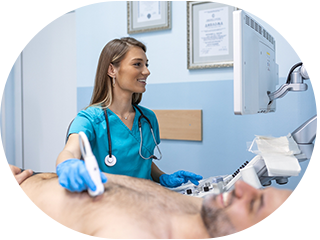
What are ambulatory ECG monitors?
Ambulatory electrocardiogram (ECG) monitors are devices that help take readings of your heart’s electrical activity during your daily activities over a longer period of time. This allows your practitioner to assess your heart health outside a medical setting.
Some heart arrhythmias and symptoms occur at random, irregular times that may not be able to be captured during an appointment at the clinic. Ambulatory ECG monitors help catch these moments of irregularity and help give a fuller picture of how your heart is behaving.
There are many different types of ambulatory ECG monitors, including:
- Holter monitors
- Event monitors
- Patch monitors
- Implantable monitors
We will decide which type of device you will use based on your symptoms and individual needs, so we can get the most accurate and precise readings to help diagnose your condition.
Why might I need an ambulatory ECG monitor?
We may recommend this test as it is useful for diagnosing the causes of symptoms, such as palpitations, dizziness, chest pain, or fainting, and connecting these with changes in heart rhythm during normal daily activities.
By monitoring these together, this test can help us identify arrhythmias, assess whether any recommended treatment is truly effective, and detect conditions such as silent ischemia. It can provide valuable information for managing heart conditions more accurately than brief clinical tests.
Preparation
We advise you to shower or bathe before the monitor is fitted. Some tests require the electrodes not to be removed for 24 to 48 hours, so it may be some time before you can bathe again.
It is also important to prepare your skin beforehand. You won’t be able to use oils, lotions, creams, or other skin care products on the skin of your chest. These products can make it hard for the electrodes to stick to your skin or interfere with detecting your heart activity.
Wearing loose, easy-to-remove clothing is also recommended, as this makes placing the electrodes easier and reduces discomfort while wearing the device.
Procedure
Each type of monitor tracks and takes results differently from one another. Dr Assomull will recommend the right one depending on your symptoms.
Holter monitor
This monitor consists of electrodes attached to the chest and connected to a small battery-operated device on a strap worn around the shoulder, neck or waist. The monitor must be kept close to the body to ensure your readings are as accurate as possible.
Alongside wearing the device, you must keep a journal of your daily activities, dietary habits, sleep habits, and any notable symptoms you may experience.
Event monitors
This device is similar to a holter monitor but differs in a few ways. An event monitor takes readings for a lot longer and doesn’t continuously record. It can detect cardiac arrhythmias and automatically generate a recording when needed. You can also generate a recording whenever you experience symptoms, noting down the time that they occur and their nature.
Patch monitors
This is an adhesive patch that contains all the hardware needed to monitor and record the heart’s activity. This avoids the need for lots of wires to connect electrodes on your chest to a separate device. It can be kept on the chest for up to 2 weeks. Like other monitors, it cannot be removed while taking readings.
Most patch recorders are small enough to be worn under a t-shirt without being seen easily. Some patch monitors can also be worn to sleep, during exercises, and even in the shower.
Implantable monitors
This device, also known as an implantable loop recorder (ILR), is a small heart-recording device implanted under the skin of the left side of the chest. It is no bigger than a USB and continuously monitors your heart rate and rhythm. The device is mainly helpful in finding out the reasons for fainting without a known cause. It can also help investigate a stroke that was suspected to be caused by an arrhythmia.
It will record until the batteries run out (usually up to 3 years). There may also be a hand-held activator alongside the monitor, which allows you to notify the device to make a recording if you notice your symptoms occurring. All recordings will be wirelessly transmitted to an electronic transmitter that will be given to you along with the implant.
This device will be implanted using a local anaesthetic, so we can cut the skin and place the device under the chest. This procedure has minimal risk, although there may be a chance of infection and/or bleeding. After the procedure, you may experience some bruising and soreness around the chest where the skin is cut, but this should heal and go away with time.
Results and aftercare
We will collect the results from these devices and assess your condition. If you have abnormal readings, we will arrange an additional appointment with Dr Assomull to discuss them and your next steps. Depending on the device used, additional tests may be needed.
If you have an ILR, you should have a health check-up at least once a year while wearing the device so we can assess your condition. Once your ILR needs to be removed, we will arrange an appointment to take out the device, a similar procedure to the way it was implanted.
Dr Assomull will decide the best course of treatment depending on what we discover.
Reviews
 Living with uncertainty about your heart can be stressful. Our 24-hour monitor provides clarity and comprehensive insights into your heart’s unique rhythm, helping you take control of your cardiovascular health.